
Taraweeh Ki Dua in Arabic, English, Hindi & Urdu | Niyat, Rakats & Tarika
Taraweeh ki dua is the tasbih recited after every four rakats of Taraweeh prayer in Ramadan, beginning with “Subhana zil-mulki wal-malakut”. On this page you can read taraweeh ki dua in Arabic, Roman English, Hindi and Urdu with translation, the dua after Taraweeh, the niyat, how many rakats Taraweeh has, how to pray it, and the surahs commonly recited in it.
Taraweeh Ki Dua in Arabic (Tasbeeh e Taraweeh)
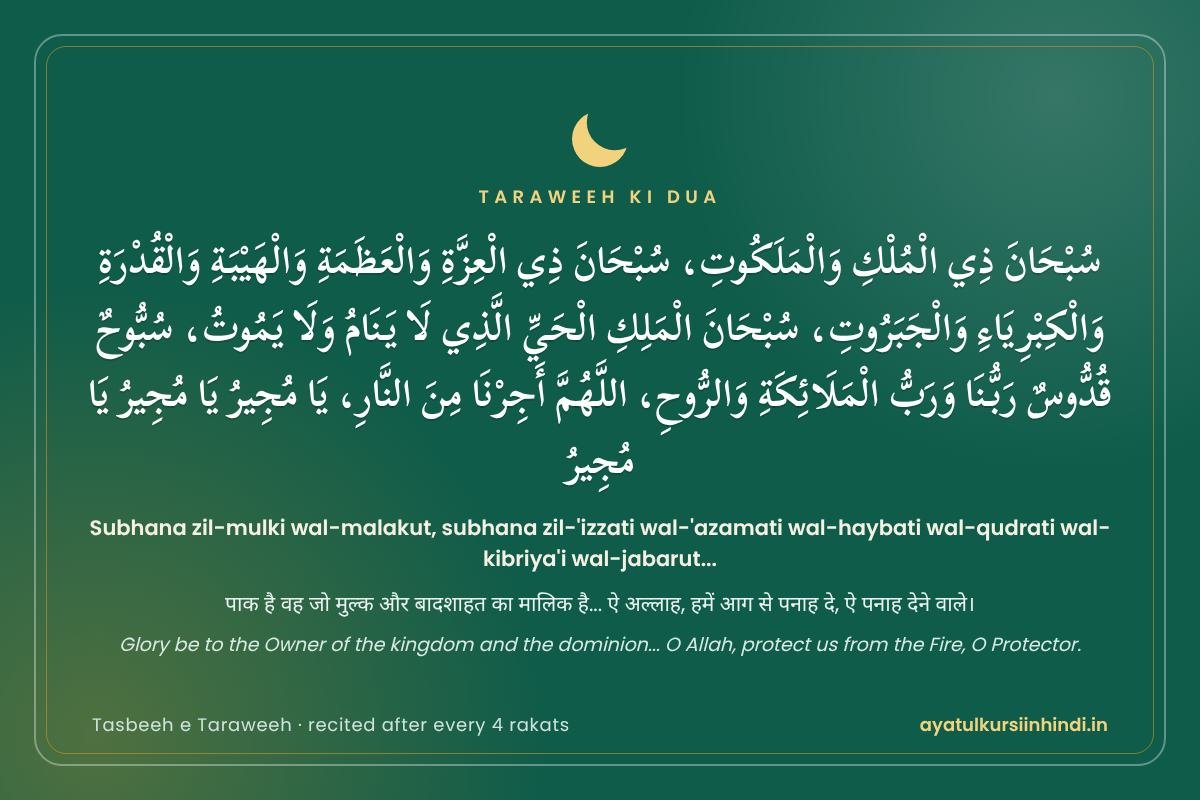
سُبْحَانَ ذِي الْمُلْكِ وَالْمَلَكُوتِ، سُبْحَانَ ذِي الْعِزَّةِ وَالْعَظَمَةِ وَالْهَيْبَةِ وَالْقُدْرَةِ وَالْكِبْرِيَاءِ وَالْجَبَرُوتِ، سُبْحَانَ الْمَلِكِ الْحَيِّ الَّذِي لَا يَنَامُ وَلَا يَمُوتُ، سُبُّوحٌ قُدُّوسٌ رَبُّنَا وَرَبُّ الْمَلَائِكَةِ وَالرُّوحِ، اللَّهُمَّ أَجِرْنَا مِنَ النَّارِ، يَا مُجِيرُ يَا مُجِيرُ يَا مُجِيرُ
Taraweeh Ki Dua in English (Roman)
Subhana zil-mulki wal-malakut. Subhana zil-‘izzati wal-‘azamati wal-haybati wal-qudrati wal-kibriya’i wal-jabarut. Subhanal-malikil-hayyil-lazi la yanamu wa la yamut. Subbuhun quddusun rabbuna wa rabbul-mala’ikati war-ruh. Allahumma ajirna minan-nar, ya mujiru, ya mujiru, ya mujir.
Taraweeh Ki Dua Translation in English
Glory be to the Owner of the kingdom and the dominion. Glory be to the Owner of honour, greatness, awe, power, pride and majesty. Glory be to the King, the Ever-Living, who neither sleeps nor dies. Most Glorified, Most Holy is our Lord, and the Lord of the angels and the Spirit. O Allah, protect us from the Fire, O Protector, O Protector, O Protector.
Taraweeh Ki Dua in Hindi – तरावीह की दुआ हिंदी में
सुब्हाना ज़िल मुल्कि वल मलकूत। सुब्हाना ज़िल इज़्ज़ति वल अज़मति वल हैबति वल क़ुदरति वल किबरियाइ वल जबरूत। सुब्हानल मलिकिल हय्यिल्लज़ी ला यनामु वला यमूत। सुब्बूहुन क़ुद्दूसुन रब्बुना व रब्बुल मलाइकति वर्रूह। अल्लाहुम्मा अजिरना मिनन्नार, या मुजीरु, या मुजीरु, या मुजीर।
हिंदी तर्जुमा: पाक है वह जो मुल्क और बादशाहत का मालिक है। पाक है वह जो इज़्ज़त, अज़मत, हैबत, क़ुदरत, बड़ाई और जबरूत वाला है। पाक है वह बादशाह जो ज़िंदा है, न सोता है न मरता है। बहुत पाक, बहुत मुक़द्दस है हमारा रब, और फ़रिश्तों और रूह का रब। ऐ अल्लाह, हमें आग से पनाह दे, ऐ पनाह देने वाले, ऐ पनाह देने वाले, ऐ पनाह देने वाले।
Taraweeh Ki Dua in Urdu – تراویح کی دعا
پاک ہے وہ جو ملک اور بادشاہت کا مالک ہے۔ پاک ہے وہ جو عزت، عظمت، ہیبت، قدرت، بڑائی اور جبروت والا ہے۔ پاک ہے وہ بادشاہ جو زندہ ہے، نہ سوتا ہے نہ مرتا ہے۔ بہت پاک، بہت مقدس ہے ہمارا رب، اور فرشتوں اور روح کا رب۔ اے اللہ! ہمیں آگ سے پناہ دے، اے پناہ دینے والے، اے پناہ دینے والے، اے پناہ دینے والے۔
Taraweeh Ki Dua Image

Is Taraweeh Ki Dua from Hadith?
No. The tasbih recited between the rakats of Taraweeh is not reported from the Prophet ﷺ in any hadith collection. It is a dhikr that scholars of the Indian subcontinent and Turkey have recited for centuries in the short rest (tarwihah) after every four rakats. Reciting it is permissible, because it contains only praise of Allah and a request for protection from the Fire, but it is not obligatory and not a Sunnah of the Prophet ﷺ. Any dhikr, durood, istighfar or silent dua may be made in that rest instead.
Dua After Taraweeh (Taraweeh Ke Baad Ki Dua)
After the 20 rakats and before Witr, this dua is commonly recited in congregation:
اللَّهُمَّ إِنَّا نَسْأَلُكَ الْجَنَّةَ وَنَعُوذُ بِكَ مِنَ النَّارِ، يَا خَالِقَ الْجَنَّةِ وَالنَّارِ، بِرَحْمَتِكَ يَا عَزِيزُ يَا غَفَّارُ، يَا كَرِيمُ يَا سَتَّارُ، يَا رَحِيمُ يَا جَبَّارُ، يَا خَالِقُ يَا بَارُّ، اللَّهُمَّ أَجِرْنَا مِنَ النَّارِ، يَا مُجِيرُ يَا مُجِيرُ يَا مُجِيرُ، بِرَحْمَتِكَ يَا أَرْحَمَ الرَّاحِمِينَ
Roman English: Allahumma inna nas’alukal-jannata wa na’uzu bika minan-nar, ya khaliqal-jannati wan-nar, birahmatika ya ‘azizu ya ghaffar, ya karimu ya sattar, ya rahimu ya jabbar, ya khaliqu ya barr. Allahumma ajirna minan-nar, ya mujiru ya mujiru ya mujir, birahmatika ya arhamar-rahimin.
हिंदी तर्जुमा: ऐ अल्लाह, हम तुझसे जन्नत माँगते हैं और आग से तेरी पनाह चाहते हैं, ऐ जन्नत और आग के पैदा करने वाले। अपनी रहमत से, ऐ ग़ालिब, ऐ बहुत बख़्शने वाले, ऐ करीम, ऐ पर्दा रखने वाले, ऐ रहीम, ऐ ज़बरदस्त, ऐ ख़ालिक़, ऐ नेकी करने वाले। ऐ अल्लाह, हमें आग से पनाह दे, ऐ पनाह देने वाले। अपनी रहमत से, ऐ सबसे ज़्यादा रहम करने वाले।
Translation: O Allah, we ask You for Paradise and seek refuge in You from the Fire, O Creator of Paradise and the Fire. By Your mercy, O Mighty, O Forgiving, O Generous, O Concealer, O Merciful, O Compeller, O Creator, O Kind. O Allah, protect us from the Fire, O Protector, O Protector, O Protector, by Your mercy, O Most Merciful of the merciful.
This dua, like the tasbih, is a customary supplication and not from a specific hadith. Many people also recite durood and make their own dua at this point.
Taraweeh Ki Niyat (Intention)
The intention is in the heart. If you wish to say it, you may say in your own language: “I intend to pray two rakats of Taraweeh Sunnah, for Allah, facing the Kabah, behind this imam.” In Arabic it is often said as:
نَوَيْتُ أَنْ أُصَلِّيَ رَكْعَتَيْ صَلَاةِ التَّرَاوِيحِ سُنَّةَ رَسُولِ اللَّهِ لِلَّهِ تَعَالَى
Roman English: Nawaytu an usalliya rak’atay salatit-tarawihi sunnata rasulillahi lillahi ta’ala.
Translation: I intend to pray two rakats of Taraweeh prayer, the Sunnah of the Messenger of Allah, for Allah the Exalted. Add “behind this imam” (khalfa hazal-imam) when praying in congregation.
What Is Taraweeh?
Taraweeh is the voluntary night prayer of Ramadan, prayed after Isha and before Witr, in sets of two rakats. The word comes from tarwihah, meaning a rest, because the people rest briefly after every four rakats. It is the same prayer the Quran and hadith call Qiyam Ramadan (standing in prayer in Ramadan).
Taraweeh in Hadith
Abu Hurairah (may Allah be pleased with him) reported that the Prophet ﷺ said: whoever stands in prayer in Ramadan out of faith and hope of reward, his previous sins are forgiven. (Sahih al-Bukhari: 2009; Sahih Muslim: 759)
The Prophet ﷺ led the companions in this prayer in the masjid on a few nights of Ramadan, then stopped coming out, saying he feared it would be made obligatory on them. (Sahih al-Bukhari: 2012) In the caliphate of Umar (may Allah be pleased with him), the people were gathered behind one imam, Ubayy ibn Ka’b, and Taraweeh has been prayed in congregation ever since. (Sahih al-Bukhari: 2010)
Is Taraweeh Sunnah or Nafl?
Taraweeh is Sunnah muakkadah (an emphasised Sunnah) for both men and women, according to the four schools of fiqh. It is not fard; a person who misses it is not sinful like one who misses a fard prayer, but it should not be left without reason, because the Prophet ﷺ prayed it and the companions kept it in congregation. Praying it in congregation in the masjid is Sunnah for men; a woman may pray it at home.
How Many Rakats in Taraweeh?
| Practice | Rakats | Basis |
|---|---|---|
| Hanafi, Shafi’i, Hanbali (majority practice in India and Pakistan) | 20 rakats + 3 Witr | Practice of the companions from the time of Umar (may Allah be pleased with him) |
| Maliki (Madinah tradition) | 36 rakats | Practice of the people of Madinah |
| Some scholars and many Arab masjids | 8 rakats + 3 Witr | Aishah (may Allah be pleased with her) said the Prophet ﷺ did not pray more than 11 rakats at night, in Ramadan or outside it (Sahih al-Bukhari: 1147) |
Both 8 and 20 are prayed by Muslims around the world, and scholars accept both as valid. Follow your masjid and your school, and do not argue over the number; the goal is standing in prayer with the Quran.
Taraweeh Ki Namaz Ka Tarika (How to Pray Taraweeh)
- Pray Isha first, including its Sunnah.
- Make the niyat for two rakats of Taraweeh.
- Pray two rakats like any Sunnah prayer: Al-Fatihah and a surah in each rakat, ruku, two sajdahs, attahiyat, durood, dua and salam.
- Repeat in sets of two until four rakats are complete.
- Rest briefly after every four rakats. Here the taraweeh ki dua above is recited, or any dhikr.
- Continue until 20 rakats (or 8) are complete.
- Recite the dua after Taraweeh, then pray 3 rakats Witr in congregation.
Surahs for Taraweeh (Taraweeh Ki 10 Surah)
In the masjid the imam usually completes the whole Quran over the month. When praying alone, or when the imam is not a hafiz, the last ten surahs of the Quran are commonly recited in order, one in each rakat, twice over to make 20 rakats:
- Surah Al-Fil (105)
- Surah Quraysh (106)
- Surah Al-Ma’un (107)
- Surah Al-Kawthar (108)
- Surah Al-Kafirun (109)
- Surah An-Nasr (110)
- Surah Al-Masad (111)
- Surah Al-Ikhlas (112)
- Surah Al-Falaq (113)
- Surah An-Nas (114)
Any surah or verses may be recited; there is no fixed list in the hadith.
Taraweeh for Women (Aurat Taraweeh Kaise Padhe)
Women pray Taraweeh in the same way, the same number of rakats, at home or in the masjid where arrangements exist. At home a woman may pray alone or lead other women. During menstruation Taraweeh is not prayed, and it is not made up afterwards, since it is a Sunnah prayer.
Frequently Asked Questions
It is the tasbih “Subhana zil-mulki wal-malakut” recited in the rest after every four rakats of Taraweeh. It is a customary dhikr, not from a hadith, and any other dhikr may be recited in its place.
After every four rakats, during the short rest, while sitting. Some also recite it after the full 20 rakats before Witr.
20 rakats in most masjids of India, Pakistan and Bangladesh, and 8 in many Arab masjids. Both are accepted; Witr is prayed after it.
Sunnah muakkadah for men and women. It is not fard, but it should not be left without reason.
Yes. It is valid at home, alone or with family. For men, the congregation in the masjid carries more reward.
If you prayed Witr with the imam and then want to pray more, you may pray nafl in twos; do not repeat Witr. It is better to pray Taraweeh before Witr.
Both are night prayers. Taraweeh is prayed after Isha in Ramadan, usually in congregation. Tahajjud is prayed after sleeping, in the last part of the night, all year round. In Ramadan one may pray both.


One Comment