
Wazu Ki Dua: Before & After Wudu in Arabic, Hindi, Urdu | Wazu Ka Tarika
Wazu ki dua has two parts: Bismillah before starting wudu, and the dua after wudu that opens the eight gates of Paradise, according to the hadith. On this page you can read wazu se pehle ki dua and wazu ke baad ki dua in Arabic, Roman English, Hindi and Urdu with translation, wazu ka tarika step by step, the faraiz and sunnats of wudu, and what breaks wudu.
Wazu Se Pehle Ki Dua (Dua Before Wudu)
بِسْمِ اللَّهِ
Roman English: Bismillah.
हिंदी: बिस्मिल्लाह। (अल्लाह के नाम से।)
اللہ کے نام سے۔
The Prophet ﷺ said: there is no wudu for the one who does not mention the name of Allah over it. (Sunan Abu Dawud: 101; Sunan Ibn Majah: 399) Scholars explain this as meaning the wudu is incomplete in reward, not invalid, so if you forget Bismillah the wudu is still valid. Many people say the full Bismillahir-Rahmanir-Rahim, which is also fine.
Wazu Ke Baad Ki Dua (Dua After Wudu) in Arabic
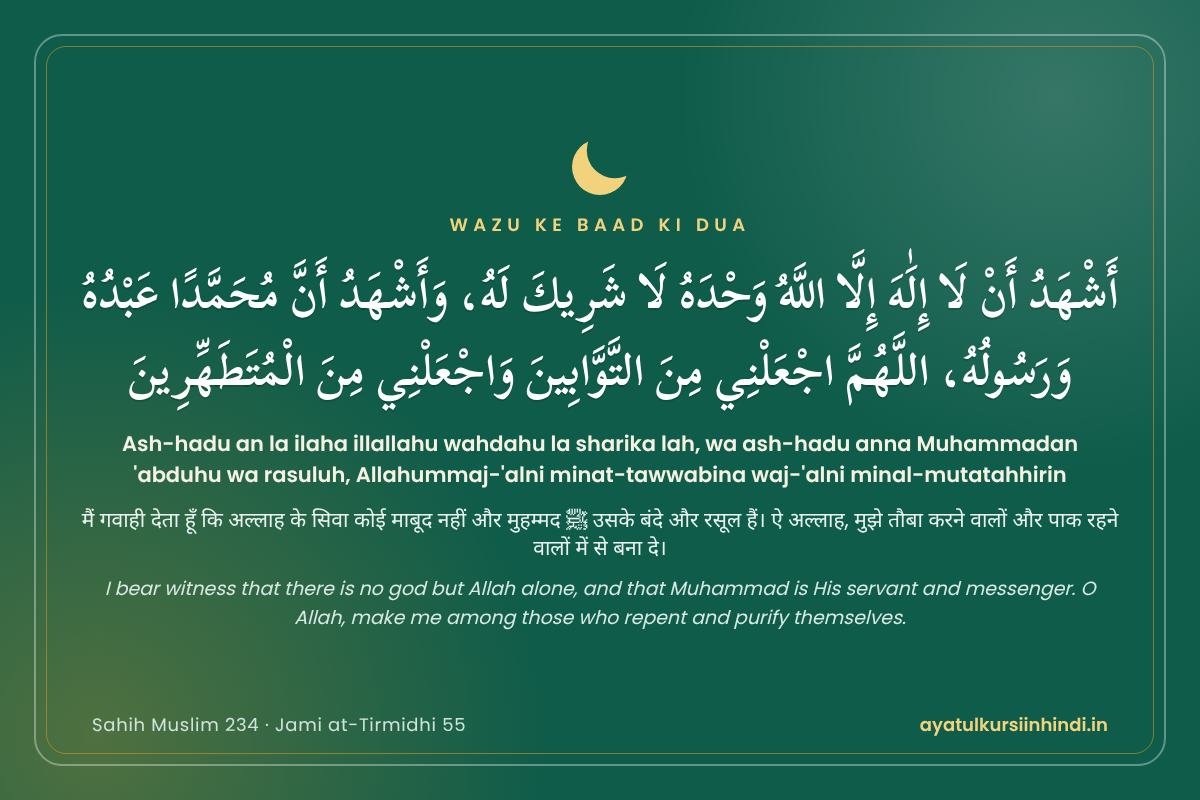
أَشْهَدُ أَنْ لَا إِلَٰهَ إِلَّا اللَّهُ وَحْدَهُ لَا شَرِيكَ لَهُ، وَأَشْهَدُ أَنَّ مُحَمَّدًا عَبْدُهُ وَرَسُولُهُ، اللَّهُمَّ اجْعَلْنِي مِنَ التَّوَّابِينَ وَاجْعَلْنِي مِنَ الْمُتَطَهِّرِينَ
Sahih Muslim: 234; Jami at-Tirmidhi: 55
Wazu Ke Baad Ki Dua in Roman English
Ash-hadu an la ilaha illallahu wahdahu la sharika lah, wa ash-hadu anna Muhammadan ‘abduhu wa rasuluh. Allahummaj-‘alni minat-tawwabina waj-‘alni minal-mutatahhirin.
Wazu Ke Baad Ki Dua in Hindi – वुज़ू के बाद की दुआ
अश्हदु अन ला इलाहा इल्लल्लाहु वहदहू ला शरीका लह, व अश्हदु अन्ना मुहम्मदन अब्दुहू व रसूलुह। अल्लाहुम्मज अलनी मिनत्तव्वाबीना वज अलनी मिनल मुततह्हिरीन।
हिंदी तर्जुमा: मैं गवाही देता हूँ कि अल्लाह के सिवा कोई माबूद नहीं, वह अकेला है, उसका कोई शरीक नहीं, और मैं गवाही देता हूँ कि मुहम्मद ﷺ उसके बंदे और रसूल हैं। ऐ अल्लाह, मुझे तौबा करने वालों में से बना दे और मुझे पाक रहने वालों में से बना दे।
Wazu Ke Baad Ki Dua in Urdu – وضو کے بعد کی دعا
میں گواہی دیتا ہوں کہ اللہ کے سوا کوئی معبود نہیں، وہ اکیلا ہے، اس کا کوئی شریک نہیں، اور میں گواہی دیتا ہوں کہ محمد ﷺ اس کے بندے اور رسول ہیں۔ اے اللہ! مجھے توبہ کرنے والوں میں سے بنا دے اور مجھے پاک رہنے والوں میں سے بنا دے۔
Translation in English
I bear witness that there is no god but Allah alone, who has no partner, and I bear witness that Muhammad is His servant and messenger. O Allah, make me among those who repent, and make me among those who purify themselves.
Wazu Ki Dua Image
Wazu Ki Dua in Hadith
Umar ibn al-Khattab (may Allah be pleased with him) reported that the Prophet ﷺ said: whoever performs wudu well and then says, “Ash-hadu an la ilaha illallahu wahdahu la sharika lah, wa ash-hadu anna Muhammadan ‘abduhu wa rasuluh”, the eight gates of Paradise are opened for him, and he may enter by whichever he wishes. (Sahih Muslim: 234) The addition “Allahummaj-‘alni minat-tawwabin…” is in the narration of Tirmidhi. (Jami at-Tirmidhi: 55)
Third Dua After Wudu
Abu Sa’id al-Khudri (may Allah be pleased with him) reported that the Prophet ﷺ said that whoever says this after wudu, it is written on a parchment and sealed, and not broken until the Day of Judgement:
سُبْحَانَكَ اللَّهُمَّ وَبِحَمْدِكَ، أَشْهَدُ أَنْ لَا إِلَٰهَ إِلَّا أَنْتَ، أَسْتَغْفِرُكَ وَأَتُوبُ إِلَيْكَ
Roman English: Subhanakallahumma wa bihamdik, ash-hadu an la ilaha illa ant, astaghfiruka wa atubu ilayk.
Translation: Glory and praise be to You, O Allah. I bear witness that there is no god but You. I seek Your forgiveness and turn to You in repentance. (Sunan an-Nasa’i, Amal al-Yawm wal-Laylah)
Wazu Ka Tarika (How to Perform Wudu Step by Step)
Uthman (may Allah be pleased with him) demonstrated the wudu of the Prophet ﷺ and said: whoever performs wudu like this and then prays two rakats without letting his mind wander, his previous sins are forgiven. (Sahih al-Bukhari: 164; Sahih Muslim: 226) The steps are:
- Niyat and Bismillah. Intend to purify yourself for prayer, and say Bismillah.
- Wash both hands up to the wrists, three times, starting with the right.
- Rinse the mouth three times (use the miswak or brush first if possible).
- Rinse the nose three times: take water in with the right hand, blow it out with the left.
- Wash the face three times, from the hairline to below the chin and from ear to ear. Run wet fingers through a thick beard.
- Wash the right arm up to and including the elbow, three times, then the left arm.
- Wipe the head once with wet hands, from the front to the back and back to the front.
- Wipe the ears once: index fingers inside, thumbs behind.
- Wash the right foot up to and including the ankle, three times, passing a finger between the toes, then the left foot.
- Recite the dua after wudu facing the qiblah if possible.
Wazu Ke Faraiz (Obligatory Acts of Wudu)
Allah says in the Quran: when you rise for prayer, wash your faces and your hands up to the elbows, wipe your heads, and wash your feet up to the ankles. (Surah Al-Ma’idah, 5:6) From this verse the four faraiz of wudu in the Hanafi school are:
- Washing the whole face once.
- Washing both arms including the elbows once.
- Wiping at least a quarter of the head once.
- Washing both feet including the ankles once.
In the Shafi’i, Maliki and Hanbali schools, the intention and the order of the limbs are also obligatory, and the Malikis and Hanbalis require the whole head to be wiped. Washing three times, rinsing the mouth and nose, and wiping the ears are Sunnah in all schools.
Wazu Todne Wali Cheezein (What Breaks Wudu)
- Anything that comes out of the front or back passage: urine, stool, wind.
- Deep sleep lying down or leaning, in which the body relaxes.
- Loss of consciousness, fainting or intoxication.
- Flowing blood or pus from a wound (Hanafi school); in the Shafi’i school this does not break wudu.
- Vomiting a mouthful (Hanafi school).
- Touching the private part with the bare hand (Shafi’i, Maliki, Hanbali; not in the Hanafi school).
- Laughing aloud in salah (Hanafi school).
Eating, drinking, talking, taking off clothes or crying do not break wudu. If you are in doubt whether wudu broke, the rule is that it remains valid until you are sure it broke. (Sahih al-Bukhari: 137)
Virtues of Wudu
- Sins fall away with the water: when a Muslim washes his face, every sin he looked at leaves with the last drop; when he washes his hands, every sin his hands touched; when he washes his feet, every sin his feet walked to. (Sahih Muslim: 244)
- On the Day of Judgement the Prophet ﷺ will recognise his Ummah by the brightness on the limbs of wudu. (Sahih al-Bukhari: 136)
- Sleeping in a state of wudu is Sunnah, and an angel stays with the one who sleeps in wudu. (Sahih al-Bukhari: 247)
Frequently Asked Questions
Bismillah, or Bismillahir-Rahmanir-Rahim. The hadith says there is no complete wudu without mentioning Allah’s name.
“Ash-hadu an la ilaha illallahu wahdahu la sharika lah, wa ash-hadu anna Muhammadan ‘abduhu wa rasuluh, Allahummaj-‘alni minat-tawwabina waj-‘alni minal-mutatahhirin.” It is in Sahih Muslim and Tirmidhi, and the eight gates of Paradise are opened for the one who says it.
Yes. The dua before and after wudu is Sunnah. Wudu is valid as long as the four faraiz are done.
Regular nail polish forms a layer that stops water reaching the nail, so wudu is not valid with it. Remove it before wudu, or use it only during menstruation when prayer is not offered. Henna is fine because it does not form a layer.
Looking does not break wudu. Touching a spouse does not break wudu in the Hanafi school; in the Shafi’i school skin-to-skin touch with desire does. Follow your own school.
Yes. As long as nothing has broken it, one wudu is enough for as many prayers as you wish. Making a fresh wudu for each prayer is a virtue, not a requirement.


One Comment